What you need to know before reading:
Maria Mihăescu, known as ‘Cycling Mița’ (‘Mi’ pronounced like ‘me’ in ‘meet,’ ‘ța’ like ‘tsa’ in ‘pizza’), was a famous high-society courtesan in Romania during the Belle Époque and interwar period (approximately 1885–1968).
At the time, Romanians admired French culture, adopting French as a prestige language and embracing Parisian fashion, architecture, and etiquette as symbols of sophistication.
Mița was famously rumored to have been the mistress of King Ferdinand I (1865–1927), who ruled Romania from 1914 until his death.
Her ironic nickname was coined by George Ranetti, editor-in-chief of a satirical magazine, after she rejected his advances. He combined a crude twist on ‘Maria’ with the fact that she was the first woman seen pedaling a bicycle around Bucharest.
Ranetti mocked her in satirical poems. An English equivalent might read: ‘Madame Mița, pedaling fast, fell down hard and broke her as… Asked the doctor, feeling blunt, why my neighbor’s such a cu… Cut my finger, just my luck, bled so much I yelled out fu… Funny how the groom was tricked, found the bride had such a di… Dinner guests behaved so bad, broke my china, wife went ma… Madame Mița, pedaling fast…’
You have to pay attention. You never know what you’ll discover wandering alone through Bucharest. Take the other day—I couldn’t find Eden Garden. Of all people, I asked for directions from Cycling Mița. My friends were already waiting, but I sent them a WhatsApp message that I was going to be late.
‘Is that really how you’re dressed for a soirée?’
I glanced down at my plain office dress, then at her. Vintage half-hat perched gracefully, two blonde curls glowing in the late-afternoon sunlight. A coral blouse with intricately embroidered butterfly sleeves and perfectly tailored purple velvet trousers. Embarrassed, I lowered my gaze to count the spokes on her silver-handlebar bicycle parked outside her house.
‘Oh, you must be—’
‘Maria Mihăescu. Viens avec moi.’
She took my hand, guiding me into the house on Amzei Street, its balconies adorned with angel carvings, pristine white façade in impeccable Art Nouveau style. We climbed the stairs into a drawing room covered in floral wallpaper. She opened a massive, intricately carved wooden wardrobe, twice the size of my Ikea closet.
‘This is where I keep my accessories,’ she explained. ‘A large accessory distracts attention from an otherwise… modest outfit.’
‘We call them <<statement>> accessories nowadays.’
‘Prends ça!’ She handed me an oversized, three-colored scarf.
‘Wear it casually around your shoulders,’ she said, carefully arranging it on me for about ten minutes. It smelled of roses.
‘What a beautiful perfume!’
‘Eau de printemps,’ she smiled. ‘I had the first bottle in Bucharest, a gift sent to me straight from Paris.’
‘Who gave it to you?’
‘Leopold. King of Belgium. One of the first gentlemen I ever… encountered. He was quite generous, supported my studies in Paris. A true patron of young female students.’
‘Have you known many kings?’
‘I think they were three. One gave me this very house. Ferdi. He would have made a good husband if he hadn’t been so possessive! And, you know, already married. He insisted on strolling down Calea Victoriei arm-in-arm at least every three days, showing everyone I was his. Never spend too much time with a jealous man, no matter how much he spends on gifts. For a time, he even forbade me from seeing anyone else. Poor George, it broke his heart.’
‘You mean King Ferdinand and George Ranetti?’
‘Yes, the prince and the pauper. Ranetti was talented, but what could I possibly do with a minor writer? Best not get involved with them. They’re hardly worth the publicity.’
‘Did the poems he published upset you?’
‘Ah, s’il te plaît! Don’t remind me of that monstrosity! Quelle horreur! Best avoided—him and Octavian Goga both.’
‘What kind of men do you prefer?’
‘Painters. Their gifts become more valuable with time. They age gracefully. Ceci est un Grigoresco, par exemple. But above all, I admire men with dignity and respectability. I once knew a doctor who became mayor without even running for office.’
‘Did you love him?’
‘Ah, toujours l’amour! A woman like me could hardly afford to love only one man. Mais oui. We were quite alike.’
‘How?’
‘Il était un peu fou et excentrique. To write a medical essay, he hanged himself voluntarily twelve times. Nearly died. Il était dédié.’
‘Did he ask you to marry him?’
‘No, but when we were together, King Manuel of Portugal proposed to me—and like a fool, I refused him.’
‘Were you ever married?’
‘Yes, to the General. He tricked me terribly. Looked serious enough but had too many passions that drained all his money. I was no longer young, had to rent out the house, couldn’t entertain guests anymore.’
‘Were you born in Bucharest?’
‘Ça n’importe pas. But I came here when I was fourteen. Unlike other girls, I didn’t run away from home—I came with my mother’s blessing. Maman wanted a better life for me.’
‘What’s your favorite memory?’
‘My first ride on the bicycle. The aristocrats at Capşa, the bourgeoisie at Oteteleșanu, and the bohemians at Kubler—all day long, chitty-chatty about politics. You should’ve seen their faces, frozen mid-sip of coffee when a woman pedaled past them.’
‘You’re a true role model for modern women, sparking conversations about gender equality. What advice would you give women today?’
‘Dare to be different. When everyone else bathed in the sea wearing robes, I wore a two-piece swimsuit.’
‘How did your contemporaries react to that boldness?’
‘The first time, the local policeman shouted for me to get out of the water. I pretended not to hear. Then he whistled. I came out—but only to hit him over the head with my parasol. Who did he think I was, some common girl he could whistle at?’
‘Were you competing with many beauties of your day?’
‘They tried their best—Mimi Whim, Iron Butt. One received a necklace with 140 diamonds from an Egyptian prince. I complained to Ferdi that he didn’t love me enough. That’s when he bought me this house. Four million he paid for it.’
‘If money hadn’t been an issue, what would you have done differently?’
‘Hmm. Exactly the same thing—but I’d have dined more often at Athénée Palace. I’ve had a beautiful life.’ She yawned, hiding the tears in her eyes.
‘You’re tired. I should let you rest.’
‘I’ll see you out.’
On the stairs, the chandeliers vanished, and the air turned sour with the smell of urine. A homeless man curled up in a corner. Madame Mița no longer shone. Outside, she saw the plaque:
‘Historical Monument. 1900.’
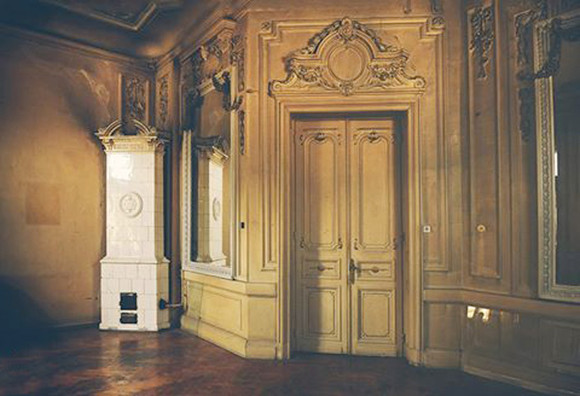
‘Mai-son Cy-Cling Mi-ța. Mița, is that me? Je m’appelle Maria! Such a brute! Fils de pute!’ she exclaimed, stepping back through the closed door. There were streaks of dirt on the bas-reliefs. The cherubs, lions, and cupids had lost noses, wingtips, tails.
I glanced at my phone. My WhatsApp message hadn’t gone through. But it was alright, I was going to get to the Eden Garden on time. The scarf reeked now, unbearably, of wilted flowers.
^Photo taken from this article.


 shortstoryside.com